
By Ben, EZ Haulaway · Published · Updated
Concrete Disposal in Douglas County: Where It Goes and What It Costs
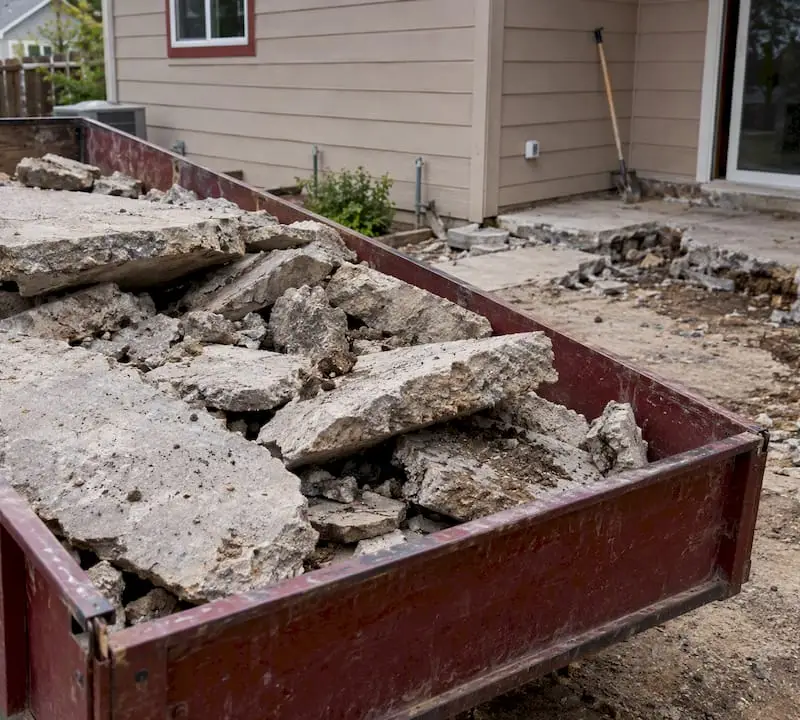
If you have a broken patio, a torn-out driveway or a pile of slab chunks, you have two realistic options. You can haul it yourself to a recycling yard that takes clean concrete, or you can pay a crew to load it and take it away. Douglas County has no curbside pickup for this, and Denver’s city programs do not cover it either. This guide explains where concrete can go, what makes a load clean, what to do with an old water heater while you are at it, and when hiring a hauler costs less than doing it yourself.
TL;DR
- Douglas County does not run residential curbside trash service, so concrete is your responsibility to haul or to hire out (Douglas County).
- Denver’s Large Item Pickup refuses construction materials such as concrete, bricks, fencing and pallets, so do not count on city programs (City and County of Denver).
- Aggregate recycling yards in the metro area take concrete as drop-off only. Clean loads are the cheapest. Rebar, trash, dirt and wood raise the cost or get a load rejected.
- Water heaters are not accepted by the county’s household hazardous waste program. Pickup and drop-off options exist, listed below.
- If you would rather not rent a truck, load heavy debris and drive across the metro, we can quote the job from a photo.
Table of Contents
- Why concrete is different from regular junk
- What the county and city will and will not do
- Where clean concrete can go
- The real cost of doing it yourself
- When hiring a hauler makes sense
- What to do with an old water heater
- Local rules and checks before you haul
- Our perspective: ask what is actually in the pile
- Get a quote for your cleanup
- FAQ
- Sources
Why concrete is different from regular junk
Concrete is dense. A single cubic yard of broken slab weighs well over a ton, which is why a pickup bed fills its weight limit long before it fills its space. Trash haulers and neighborhood dumpsters often refuse it or charge heavy-material rates, and a standard residential trash container is not meant for it.
It is also one of the most recyclable construction materials. Yards crush clean concrete into aggregate that is reused as road base and fill. That is why disposal here usually means taking it to a recycler, not a landfill.
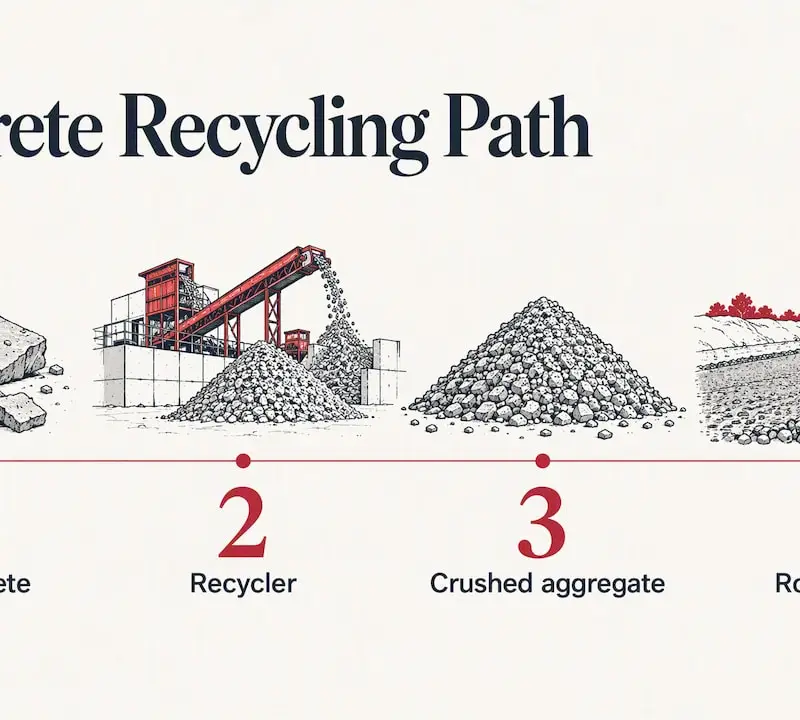
The catch is the word clean. A recycler wants concrete, not a mix of everything that came out of your backyard.
What the county and city will and will not do
Douglas County states that it does not provide residential curbside trash pickup and encourages residents to find the most economical and practical way to dispose of their own trash (Douglas County Public Works). That means the question of who takes your concrete is a private-market question: you, a recycler, or a hauler.
Two local facilities people often confuse with concrete options do not work for it:
- The seasonal slash-mulch and green-waste site on Delva Way takes tree limbs, brush, leaves, sod and similar yard material. Its exclusions include appliances, household trash and lumber, and it is not a place for rubble (Douglas County).
- Denver’s Large Item Pickup is for Denver residents, and it does not accept concrete, bricks, fencing or pallets (City and County of Denver). If you live in Parker, Castle Rock, Highlands Ranch or Lone Tree, that program is not yours anyway.
If you searched for “Denver” concrete recycling and live in Douglas County, treat Denver’s rules as background. Your options are the same private recycling yards that serve the whole metro area.
Where clean concrete can go
The regional construction and deconstruction directory kept by Boulder County lists several facilities across the Front Range that accept asphalt and concrete or aggregates. It marks facilities in Commerce City and Englewood as drop-off only, with no hauling service (Boulder County). The same directory lists a Golden yard that takes concrete, brick, block, cinder block, masonry and clean-fill rock, sand and gravel.
What that tells you in practice:
- Aggregate recycling yards are the primary destination. They are commercial sites that weigh or inspect your load at the gate.
- Most are drop-off only. They will not come to your house. You bring the material in a truck or trailer.
- Pricing is by load or by weight, and clean concrete is often accepted free or cheaply. Concrete with embedded steel, such as rebar or wire mesh, commonly carries a small fee because it takes extra processing. Many yards also have a minimum charge for any load.
- Hours are weekday and short Saturday windows. Plan on daytime, and confirm hours before you drive. Do not trust a listing that is a year old.
- Mobile crushing also exists for large projects such as a full driveway or commercial demolition, where a crusher comes to the site. That only makes sense for very large volumes.
Call the yard before you load. Ask what counts as clean, whether rebar is allowed and at what price, whether they take loads from homeowners, and whether they accept a trailer or only a truck.
What makes a load “contaminated”
Yards generally refuse or surcharge loads mixed with trash, plastic, wood, sod, excessive dirt or other foreign material. A load that arrives with a fence post, a bag of dirt and some old lumber on top of the slabs may be turned away, and you will have paid for the trip.
Sort before you load:
- Break the slab into pieces you can lift. Many yards prefer pieces that fit safely in a vehicle and are not oversized.
- Separate concrete from soil, roots and sod.
- Pull out wood forms, plastic sheeting and rubbish.
- Keep rebar-laden pieces apart from plain concrete so you know what you may be charged for.
- Photograph the load before you leave in case there is a dispute at the gate.
The real cost of doing it yourself
Drop-off prices at a yard can look like zero. They are not the total.
| Cost | What to count |
|---|---|
| Truck or trailer | Rental, plus fuel across the metro to the yard |
| Weight limits | Concrete overloads a trailer fast, so a big patio can take several trips |
| Your time | Breaking, loading, driving, waiting at the scale, unloading |
| Physical risk | Heavy lifting, dust and sharp edges |
| Rejected load | A return trip if the load is contaminated |
A small job, say a few stepping stones or a broken planter base, is worth hauling yourself if you already own a truck. A full patio or driveway section is a different story. A pickup bed holds far less than its volume suggests once you account for weight, and you may be driving 30 miles each way, several times.
When hiring a hauler makes sense
Hire a crew when any of these is true:
- You do not own a truck or trailer rated for heavy loads.
- The concrete is mixed with other debris, such as old fence posts, lumber, bricks, soil or a shed floor.
- You are doing a bigger cleanup: a deck, fence, shed or garage removal where the concrete is only part of it.
- You are a property manager or contractor with a deadline.
- You physically cannot, or do not want to, lift it.
Our construction debris removal service covers job-site and renovation waste, and our deck and fence removal team handles light demolition. Because heavy material changes what a trailer can carry, send us a photo of what you have and we will tell you whether we can take it and what it will cost before anyone drives out. Our instant estimate takes a photo and gives you a quote without a site visit.
How our pricing works for a cleanup like this
We price by how much of our trailer your debris fills. The published rates, with labor, loading, haul-away and cleanup included:
| Load size | Price |
|---|---|
| Minimum / small load | $120 |
| 1/8 trailer | $120 |
| 1/4 trailer | $240 |
| 3/8 trailer | $360 |
| 1/2 trailer | $420 |
| 5/8 trailer | $540 |
| 3/4 trailer | $660 |
| 7/8 trailer | $780 |
| Full trailer | $840 |
If the job needs more hands, additional labor is $50 per hour per crew member. The full list, including individual items, is on our pricing page. Heavy loads such as concrete are quoted from your photo, so you know the figure before booking.
What to do with an old water heater
A water heater is the other item that sends Douglas County residents searching. It is a bulky metal appliance, and the county’s household hazardous waste program does not accept appliances (Douglas County Health Department).
The county’s household waste page points to alternatives by type:
- A pickup service for working water heaters that are under seven years old.
- A free metal pickup that takes metal goods, including items that contain refrigerant.
- A nonprofit home-improvement resale store that accepts appliance drop-offs and offers free pickup.
Each has conditions, so call first. A heater that is old, leaking or corroded is unlikely to qualify as a working donation, and scrap metal outlets generally want it drained and disconnected. The county’s page is the place to check current contact details.
Prepare the heater before anyone moves it
A water heater that is still plumbed in is a job for a plumber. Turn off the power or gas supply and the water, let the tank cool, and drain it before it is moved. A full tank holds dozens of gallons and is heavy and hot. If you are not comfortable disconnecting a gas line or electrical connection, hire a licensed plumber or electrician for that part.
Once it is disconnected and drained, it is an appliance haul. We take appliances, and our appliance removal page covers what we handle. Refrigerators run $150, washers and dryers are $100 per unit, and appliances that contain Freon carry a $100 per-unit handling fee. Water heaters are quoted from a photo, and if one is part of a larger load, it simply takes up space in the trailer.
Local rules and checks before you haul
Before you load anything, run through this list:
- Confirm the facility accepts homeowners. Some yards serve contractors and businesses first.
- Ask about the fee for steel-reinforced concrete. The cost depends on the yard.
- Check opening hours. Weekday daytime and short Saturday hours are common.
- Get a quote for the minimum charge. Many yards charge a floor fee even for a small load.
- Cover the load. Loose debris on the road is a safety and legal problem.
- Check HOA and permit rules if you are demolishing a patio, driveway or slab. Your city or county building department can tell you if a permit applies.
- Hazardous materials stay separate. Paint, solvents and chemicals go to the county’s household hazardous waste program, which partners with a waste company for year-round pickup at $30 per appointment (Douglas County Health Department).
Our perspective: ask what is actually in the pile
Most concrete calls we get start with “I just need the slab gone.” Then we look at the photo and it is slab, a rotted fence, three bags of landscape rock and a pile of old lumber. The concrete itself may be recyclable, but the pile as a whole is not a clean load, and the person who tried the yard route first usually learned that at the scale.
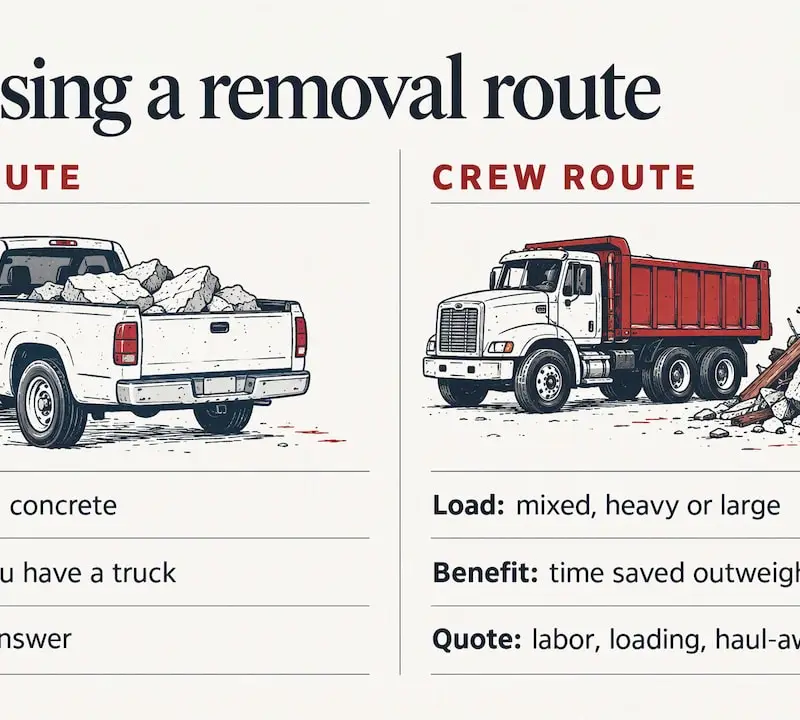
Our honest advice is to decide based on the mix. If it is all clean concrete and you have a truck, the yard is the cheap answer. If it is mixed, heavy or large, the time you save is worth more than the fee. We are a family-owned crew based in Parker, not a call center, so the person who looks at your photo is the person who sends the crew. We price from the photo up front, and that quote covers labor, loading, haul-away and cleanup. We also donate and recycle what we can.
One more thing we learned the hard way: do not overfill a rental trailer with concrete. It looks small and weighs a lot.
— Ben
Get a quote for your cleanup
If you are clearing out a yard, garage or old structure in Parker, Lone Tree, Castle Rock, Highlands Ranch or elsewhere in Douglas County, start with a photo. Send it through our instant estimate and you will get a price before you commit. Property managers and contractors can see how we handle bigger jobs on our commercial junk removal page, and Lone Tree residents can look at our Lone Tree service area.
FAQ
Can I dispose of concrete for free in Douglas County?
Often, yes, if it is clean and you haul it yourself. Aggregate recycling yards around the metro area commonly accept clean concrete for little or nothing, and may charge for loads containing rebar or wire mesh. Always call the yard for its current fee and minimum charge. The cost of the truck, the fuel and your time is not free.
Does Denver offer concrete pickup or recycling for Douglas County residents?
No. Denver’s Large Item Pickup does not take construction materials, including concrete, bricks, fencing and pallets, and it serves Denver, not Douglas County. Douglas County itself has no residential curbside service, so you will use a recycling yard or hire a hauler.
Can I put concrete in the trash or a regular dumpster?
Generally not. Concrete is very heavy, and most residential trash containers and haulers refuse it or charge for heavy material. Check your hauler’s rules first, or take it to a recycler.
How do I get rid of an old water heater?
Shut off power or gas and water, let it cool, drain it and disconnect it, using a licensed plumber if needed. The county’s hazardous waste program does not take appliances, but its household waste page lists pickup and drop-off alternatives by type. If you would rather not move it, we can haul it away from a photo quote.
What can I not mix with concrete when I take it to a yard?
Plastic, trash, wood, sod, excessive dirt and other foreign material can get a load rejected as contaminated. Keep soil, lumber and rubbish out of the pile, and separate rebar-heavy pieces.
Sources
- Trash / Landfills, Douglas County
- Large Item Pickup, City and County of Denver
- Construction and Deconstruction, Boulder County
- Household Waste Management, Douglas County Health Department
- Douglas County slash-mulch site